
Crawford Projected Versus Actual Release
A projected date estimates when custody may end under the facts known at the time. An actual release date records when a jail or prison did release the person or transfer custody. The two are not interchangeable. A future date can move before it arrives. Even a court order that permits release may require processing, bond completion, or clearance of another hold before the person leaves the Crawford County Jail. The agency that has custody controls the physical release record, while the court order or sentence explains the legal authority used in the calculation. Pretrial detainees generally do not have a computed sentence-end date because no custody sentence has yet been imposed. The key records are the bond decision, later court orders, and the jail's hold information. A sentenced Crawford County inmate may have a term, prior jail credit, and a release calculation, but the public jail roster does not publish that computation. For a state prisoner, GDC and the Parole Board use terms such as Maximum Release Date and Tentative Parole Month. Each has a different meaning, and neither should be inferred from the county roster's “Days In Jail” field.
A transfer is not community release. Someone removed from the Crawford County roster may have entered GDC, another jail, federal custody, or immigration custody. Likewise, a state-prison parole date may lead to community supervision or to a detainer held by another authority. Read the destination field with the date whenever it is available. The projected marker answers when one custody event may end, while the receiving record answers whether another agency immediately took control. This distinction is essential when a person leaves the local roster but remains confined elsewhere. The receiving agency should confirm the next custody status and any later release date.
Find Crawford Projected Release Dates
Begin by naming the custody system. Georgia.gov directs county-jail searches to the county and state-prison searches to GDC. That division prevents a common error: treating the absence of a GDC result as proof that a Crawford County jail detainee has no record. A person who bonded out or served only a local term may never appear in the state offender query. A Crawford County Superior Court defendant sent to GDC belongs in both the court and state-record paths. The sentence record establishes the legal term, while the state record supplies the public custody and release-date fields available for that prisoner.
- Check current county custody. Search the Crawford sheriff's jail report. “Days In Jail” measures current stay length and is not a release-date field.
- Identify the sentence. Ask Crawford Superior Court or the correct local court for the sentencing, bond, modification, or revocation order.
- Ask the jail for its release record. For a local sentence, request the expected or actual release date, jail credit, and whether a hold affects physical release.
- Search the state record when GDC is involved. Open the GDC Find an Offender query and match the result by name, GDC ID, case number, age, and court facts.
- Check parole timing separately. Use the Board's Inmate TPM Lookup if the state record points to parole consideration.
- Confirm the event. Compare any future date with the agency's status after that date and with a custody-change notice or release record.
The Crawford County released-inmate search path helps when the person has vanished from the current roster and the receiving system is not yet known. If GDC shows active custody, the person is not released from state prison. If a public state record shows release, discharge, or parole data, compare it with the sentence and Board record rather than relying on a name alone. A county records request should be narrow. Give the full name, birth date or booking number if known, arrest date, and the court case. Ask for the expected or actual release date, the release type, and any transfer or detainer destination that can be disclosed. The sheriff record answers the jail event. The court order answers the legal basis. Neither should stand in for GDC when the person has entered state custody.
The official state search can be reviewed at the source. The GDC offender query shown here is the state-prison channel, not Crawford's county-jail roster.
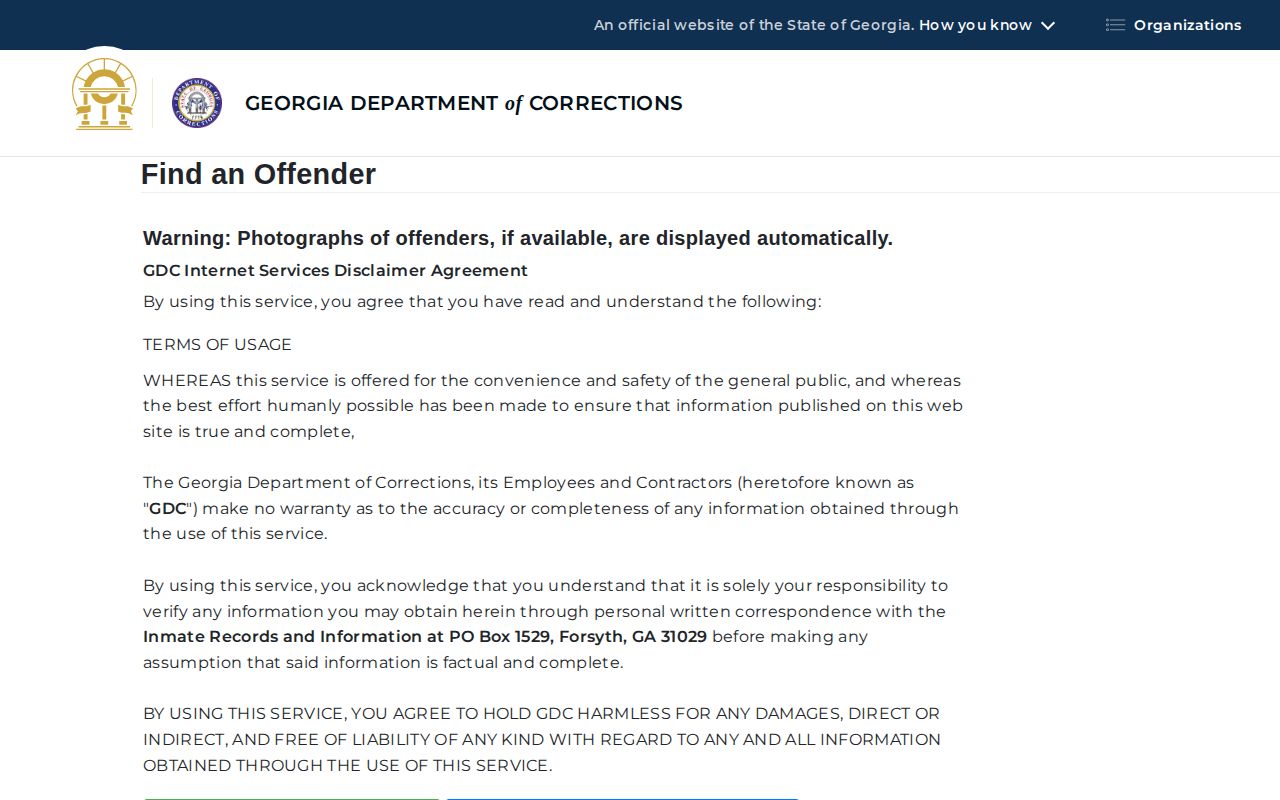
The screen reinforces why exact identifiers and the correct custody system must lead a Crawford County projected release date lookup.
Crawford Release Dates and Credits
No public Crawford County jail policy was found that supports a local good-time formula or weekend-release rule. The safe county path is to get the sentencing order, ask how much jail credit was applied, and ask the jail whether a hold blocks release. The public “Days In Jail” value does not reveal sentence credit, earned credit, parole eligibility, or hold clearance. It cannot be used to calculate the date. A local release estimate should therefore come from the sheriff or court record rather than a formula borrowed from another Georgia county. The responsible office can also identify whether the displayed sentence and actual custody calculation differ.
Georgia state-prison credits have their own rules. The GDC Performance Incentive Credit program says eligible offenders may earn up to twelve PIC points, with a possible reduction of one to twelve months from a Tentative Parole Month or Maximum Release Date. Listed categories include case-plan work, education or vocational progress, and work assignments. GDC also lists exclusions, including short sentences, minimum mandatory terms, non-parole-eligible offenses, and death sentences. Work Incentive Credits are addressed in Georgia Rules and Regulations Subject 125-3-7. The rule permits GDC to award up to one day of credit for each day of satisfactory participation in approved activity and to recommend that credits advance a tentative parole date. These credits depend on eligibility and conduct. They do not erase a mandatory-service rule or turn a TPM into a final promise. For a Crawford County state-prison case, the current GDC calculation remains the source for how an eligible credit affected a public date.
Credit data must be read with the sentence. A Maximum Release Date marks the end point under the state computation then in force. A TPM concerns possible parole review. One credit can affect either marker under the program, but a later disciplinary report or legal limit may change the result. The government record should identify which date moved and why. The PIC page also states that points come from documented goals, not merely from time passing. Two people with terms of the same length can have different public date markers because eligibility, program completion, conduct, and mandatory terms may differ. Ask which marker the credit affected. A change to the TPM does not necessarily alter the Maximum Release Date, and a change to the maximum date does not prove that parole will be granted.
Why Crawford Release Dates Change
A sentence does not always yield one fixed public date. Crawford County processing and state computation react to different events. The same factor can also have distinct effects. A detainer may not lengthen the Georgia sentence, yet it can prevent the person from entering the community after release from the first agency. Parole to a detainer is called a Conditional Transfer. A court order, credit decision, misconduct report, parole action, or receiving-agency hold can therefore change either the projected date or what happens when that date arrives. The record that owns each change should identify the new marker or destination.
| Factor | Possible date effect | Record to confirm |
|---|---|---|
| New court order | Changes the sentence, credit, bond, or release authority | Crawford court order and jail record |
| PIC or work credit | May move an eligible TPM or Maximum Release Date earlier | GDC computation and program record |
| Misconduct or unmet program step | May postpone or cancel a TPM | Parole Board decision record |
| Parole denial | Leaves the person in custody until a later review or sentence end | Board status and GDC custody record |
| Detainer or hold | May route the person to another authority instead of the community | Releasing and receiving agency records |
| Record correction | Updates a date computed from incomplete or wrong data | Agency that owns the corrected record |
Release processing can also create a gap between legal authority and physical departure. The court may authorize bond, but the Crawford County jail must verify completion and clear all holds. A parole grant can be withdrawn before its effective date. When two systems show different dates, compare when each record was updated and which agency has custody now. For pending release, a custody alert can help mark a later status change. The Crawford VINELink inmate check explains how to register for participating-agency notices, but VINE does not calculate the sentence and cannot replace the jail, GDC, court, or Board record.
Note: A detainer may change the release destination even when it does not extend the sentence recorded by the first agency.
Confirm Crawford Actual Release Dates
Confirmation means finding the record of what happened, not just a date that once appeared. For a Crawford County Jail release, request the release date and time, release reason, and destination or receiving agency if there was a transfer. Sheriff Lewis S. Walker's Records Clerk is the official local open-records channel. A court order may explain the legal cause, but it may not record the exact moment jail processing ended. Compare the order with the booking-release entry so legal authorization is not confused with the later physical departure from custody. For GDC, reopen the offender result after the date and check custody, facility, release, discharge, or parole information. If parole is involved, compare the Parolee Database and contact DCS about community supervision. For a federal prisoner, use BOP because a federal release date does not belong to the Crawford County or GDC computation. BOP says a past date with no facility shown means the person left BOP custody, though another form of custody or supervision may follow. The federal record should not be used to infer the status of a separate Georgia case.
Georgia VINE is an added notice layer for participating agencies. A release or custody-change message helps mark the event, but the jail release sheet or state discharge record carries the fuller detail. If the person has simply disappeared from the Crawford County roster, confirm whether the outcome was bond, sentence completion, transfer, or another hold before calling it community release. Record the date and wording shown by each system when asking the responsible agency to explain a conflict. A later official Crawford County status should be compared with the earlier projection rather than assumed to match it without a direct source check.
Note: A past projected date is not proof of release when the current agency record still shows active custody or transfer.
Georgia Rules Shape Crawford Dates
Georgia's release-date rules should not be reduced to an eighty-five percent slogan. The Parole Board eligibility guidance states that covered non-life serious violent felony sentences for crimes committed on or after January 1, 1995 require one hundred percent service and are not parole eligible. O.C.G.A. § 17-10-6.1 supplies the mandatory-service framework. The listed offense class includes murder, rape, aggravated child molestation, aggravated sodomy, aggravated sexual battery, armed robbery, and kidnapping. This rule controls covered Crawford County sentences despite general credit or parole concepts. Most other parole-eligible inmates reach statutory consideration after one-third of the prison sentence, but that is not a guaranteed release point. O.C.G.A. § 42-9-45 sets general eligibility thresholds and exceptions. The Board may deny parole, set a later TPM, advance a TPM based on qualifying work, postpone review for misconduct, or require a condition before release. Life sentences have separate eligibility rules tied to the offense, sentence, and date. Eligibility opens a decision process; it does not establish the date when a Crawford County prisoner will leave custody.
This is the distinctive Georgia computation issue for Crawford cases. The sentence document identifies the offense and term. GDC computes custody dates and eligible credits. The Parole Board controls parole review and decision timing. No single public field can replace all three. A Crawford court case that leads to GDC must be checked across the court order, offender record, and Board tool. For life sentences, eligibility can depend on the offense date and category, and some life terms are not parole eligible. The Board describes different review intervals across changes in Georgia law. Those intervals are eligibility points, not release dates. The exact sentence and offense date matter more than a rough fraction of the term. The state PIC description makes the credit limits visible, and the official GDC PIC page is shown in the image below.
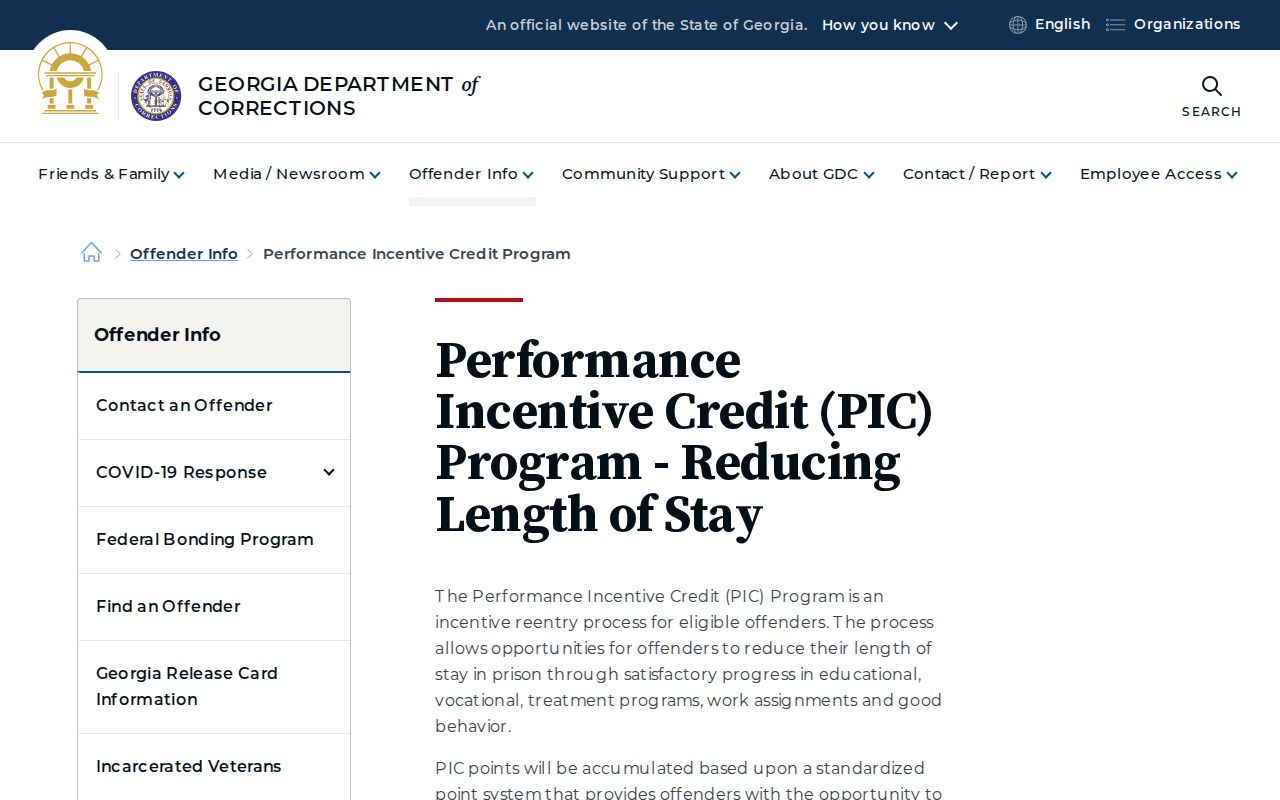
The captured page supports a careful reading: PIC can move eligible dates, but program exclusions and mandatory terms still control.