
Crawford Parole Versus Probation
Parole is a decision by the Georgia State Board of Pardons and Paroles. It lets an eligible person serve part of a prison term in the community under supervision. Probation is imposed by a court. It may replace confinement, follow a jail or prison term, or form the community part of a split sentence. A person released from Crawford County Jail on bond is not automatically on either one. Bond releases custody while the criminal case remains open. Parole follows state confinement, while a probation order can begin without a state-prison stay. That difference determines which Crawford County supervision record should be checked.
The source of authority is the best first clue. A Parole Board decision and a state-prison history point to parole. A Crawford County Superior Court sentence that states a probation term points to felony probation. Misdemeanor probation follows a local court order, but DCS says misdemeanor supervision does not reside with that agency. The named provider or court must be checked instead. The research did not identify a Crawford-specific misdemeanor provider, so no provider should be assumed. If a sentence combines confinement and probation, the court order establishes the split, while the jail or GDC record confirms when physical custody changed.
| Point | Parole | Probation |
|---|---|---|
| Who orders it | State Board of Pardons and Paroles | The sentencing court |
| Custody link | Release from a state prison term | May follow custody or replace part of it |
| Crawford record path | Parolee Database, Board record, then DCS | Crawford court order, then the assigned supervisor |
| Community agency | DCS supervises Georgia parolees | DCS handles adult felony probation, not local misdemeanor supervision |
| End point | Parole discharge or sentence end | Court-set term completion or later court order |
- Parole
- Conditional release from a prison term under community supervision.
- Probation
- Court-ordered community supervision imposed as part of a sentence.
- Discharge
- The formal end of a sentence or supervision term.
- Detainer
- A request from another authority to hold or receive a person.
Verify Crawford Post-Release Supervision
A sound Crawford County check uses the custody path, the order, and the field agency. The sheriff-linked current roster only answers whether someone is publicly listed as currently booked. It does not state that a person left on parole or probation. A person who moved from the Crawford jail to GDC remains in custody. A person listed by the parole system has left state prison but may still be serving the sentence under DCS supervision. Federal release and federal supervised release use federal records, not Georgia's parole database. Start with the last agency that held the person, then follow the record into the correct community-supervision system. Georgia VINELink can add a custody-change alert from a participating agency, but it is not the supervision record. The county sex-offender registry is also narrow in scope. It applies only to people with a qualifying registration duty and is not a general Crawford County parole and probation lookup. A court disposition can show the probation sentence, while the Parole Board and DCS records show the state parole path after release. The full county release path remains available through the Crawford County released-inmate search when the form of release is still unclear or a transfer has been mistaken for community release.
- Identify the last custody system. Use the sheriff record for a Crawford County jail booking and the GDC offender query for a state-prison case.
- Read the court sentence. Crawford Superior Court records can show a probation term, a split sentence, a revocation, or a later modification.
- Check the Board tools. Use the State Board of Pardons and Paroles links for the Inmate TPM Lookup before release or the Parolee Database after release.
- Confirm the field office. DCS lists its Macon office as serving Crawford County parolees and adult felony probationers.
- Resolve conflicts at the source. Ask the Board about a parole decision, DCS about active supervision, and the court about the sentence or probation order.
Note: Match names with a birth date, offender number, or case number before treating a supervision result as the correct person.
Crawford Supervision Runs Through Macon
Crawford County does not have the relevant DCS field office within the county. The DCS Macon Field Office serves Bibb, Crawford, Peach, and the Macon Circuit. That matters after release because the sheriff manages the jail record, while DCS manages the field-supervision layer for parole and adult felony probation. Calling the jail cannot establish every current parole condition or probation reporting detail. The jail can confirm the local custody event, but questions about active reporting, field assignment, or supervision status belong with DCS after the correct person and case have been identified. The court and Board records should first establish why supervision exists.
Georgia DCS Macon Field Office
640 North Avenue, Suite D
Macon, GA 31211
Monday through Friday, 8:00 a.m. to 4:30 p.m.
DCS statewide phone: (678) 783-4337
The office assignment also reflects Crawford's place in the Macon Circuit. A released parolee or felony probationer may live in Crawford County but report through Macon. Before a visit, confirm that the office handles the named person and ask what identifying data can be shared. The court clerk remains the source for the sentence itself. Use the statewide DCS number for an office-routing question, then rely on the assigned officer or official record for a person-specific supervision matter. The Macon office serves several counties, so a case number, GDC ID, or parole number can help distinguish similar names. If probation is in question, start with the Crawford court order. For parole, start with the Board. DCS handles active field reporting. The official office page shows the route clearly, and this Macon DCS location listing is reflected in the captured image.
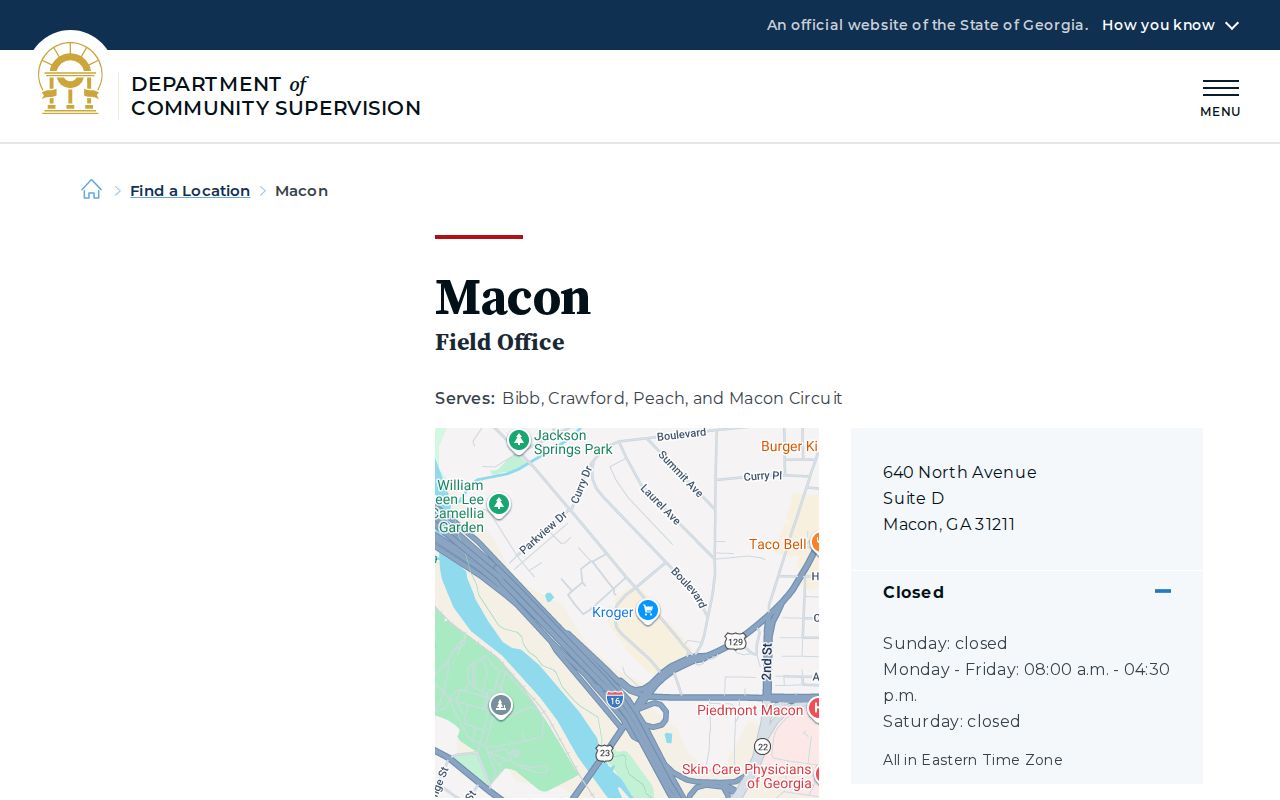
The image helps separate the county of residence from the Macon supervision office that serves Crawford County cases after release.
Crawford Supervision Violations and Warrants
Conditions are the rules attached to a parole release or probation order. Their exact text comes from the Board, DCS documents, or the sentencing court. At a high level, a breach can lead to a report, a hearing or court action, a warrant, changed terms, or a return to custody. The Crawford County jail roster has displayed probation-violation charge language tied to O.C.G.A. § 42-8-38. That proves a violation may result in a new local custody event, but the roster alone does not disclose the full violation decision. The supervising authority or court record must show whether the allegation led to a sanction, revocation, changed conditions, or no final action.
An absconder is a supervised person whose location is unknown after failing to maintain required contact. Do not infer that label because a person is absent from a public list. Confirm it through the supervising agency and the court or official warrant channel. If the person appears in the Crawford County jail again, the current roster shows custody, not the final outcome of the parole or probation matter. DCS and the Board handle parole allegations together, while a probation violation returns to the court process. A warrant can exist without a new public booking, and a new booking may involve a charge unrelated to supervision. Use the person-specific parole or court record to connect a warrant, violation claim, and later custody event. Georgia VINELink may provide an alert if a participating jail receives the person, but it does not declare the final Crawford County supervision status. The roster may identify the warrant or charge tied to the booking, while the Board, DCS, or sentencing court supplies the controlling outcome. Keeping those roles separate prevents a pending allegation from being described as a final revocation or discharge decision.
Note: “Violation” describes an allegation or proceeding until the proper Board or court makes the final controlling supervision record decision.
Crawford Parole and Probation Discharge
Supervision ends through the authority that imposed or controls it. A parole record may reach discharge when the state sentence and parole term are complete or when the Board enters the applicable action. A probation term ends under the court sentence or a later court order. Physical release from the Crawford County jail is a separate event. Someone may leave jail and begin years of supervision, while another person may finish a sentence with no community-supervision term. For parole, compare the Parolee Database with the Board record and DCS confirmation. For felony probation, obtain the Crawford Superior Court sentence and any modification, revocation, or termination order.
A disappearance from an online parole result should not be treated as proof of discharge. Public data can change, and a name mismatch can hide the correct record. A narrow records question should ask for the current status and the authority that ended supervision. The term “discharge” should not be confused with record restriction. The GBI record-restriction guidance explains that O.C.G.A. § 35-3-37 can affect public criminal-history visibility in eligible cases. It does not mean that every Crawford County court, jail, parole, or probation record was erased. For the local booking-release file, Sheriff Lewis S. Walker's office remains the source rather than the Board or DCS.
Crawford Parole Review Records
Public Board meetings are not hearings for named offender cases. The Board's published monthly meeting notice states that offender cases are not discussed or considered during those meetings. For a Crawford County person, the practical decision channels are the Inmate TPM Lookup before a possible parole release and the Parolee Database after release. The TPM marks when final review is expected. It can be moved, canceled, or followed by denial. The public meeting schedule should not be treated as an individual parole-hearing calendar or a source of named release decisions. Most parole-eligible Georgia inmates are considered after the statutory threshold, but eligibility does not guarantee release. O.C.G.A. § 42-9-45 sets general thresholds and exceptions. Covered non-life serious violent felony sentences under O.C.G.A. § 17-10-6.1 require full service and are not parole eligible. Court records identify the sentence and offense; Board records explain the parole posture. The Crawford County projected release date process gives more detail on TPM and sentence credits. The sentence date and offense category matter because not every Georgia prisoner follows the same eligibility rule.
A Board outcome may grant, deny, postpone, cancel, or withdraw parole before the effective date. It may also release a person to a detainer through a Conditional Transfer. In that case, the person leaves GDC custody for the requesting authority rather than entering the Crawford County community at once. If that authority later releases the person before the Georgia sentence ends, Board and DCS supervision may then control. The Board and GDC keep separate files, which explains why one source may show sentence and facility data while another shows a parole decision. Crawford County Superior Court holds the local sentence record, yet it does not make the state parole decision. A complete check follows the chain in order: court sentence, GDC custody, Board action, and DCS supervision. When the records conflict, the agency responsible for the disputed step should confirm it. The court can explain why the person entered state custody, GDC can confirm the confinement record, the Board can state the parole posture, and DCS can verify the community-supervision layer after release.