
Crawford County Inmate Release Meaning
A person is released from Crawford County custody when the sheriff no longer holds that person under the booking in question. That can mean freedom in the community, but it can also mean movement to another authority. The Crawford County Jail may release someone after bond is met, a local term ends, or a court orders release. It may instead transfer the person to the Georgia Department of Corrections, another county, federal custody, a medical facility, or immigration custody. The word “released” must be read with the destination.
The official Crawford jail population report is designed for current custody and fresh bookings. It is not a release archive. Its sampled records use the status “CURRENTLY BOOKED,” while “Days In Jail” measures the current stay. When a name disappears, the roster shows only that the person is no longer publicly listed there. A sheriff release entry, court order, VINE event, GDC record, or receiving-agency record is needed to explain why.
- Discharge
- The formal end of a sentence or correctional status.
- Time served
- Release after the ordered jail term, including credited time, is complete.
- Parole
- Release from prison while the person remains under state supervision.
- Probation
- Court-ordered community supervision that may follow custody or replace more custody.
Crawford County Release Types
The reason for leaving the jail determines which record should exist next. Bond does not end the criminal case. A transfer does not mean the person entered the community. Parole ends prison confinement but starts a supervised period. These distinctions prevent a missing roster entry from being mistaken for a final case result.
| Release event | What it means | Best next record |
|---|---|---|
| Bond or recognizance | The person leaves jail while the case continues. | Sheriff release entry and court bond order |
| Time or sentence served | The local custody term has ended. | Jail release record and sentencing docket |
| Court-ordered release | A judge directs release after a case event or sentence change. | Crawford court docket and signed order |
| Parole or probation | The person is in the community under stated conditions. | Parole Board, DCS, and court records |
| Transfer | Crawford custody ends because another agency accepts custody. | Receiving jail, GDC, BOP, or ICE record |
A dismissal or acquittal may supply the legal reason for release, but the jail still records the physical custody event. A medical move can also end the visible local booking without proving an unrestricted community release. Ask for both the release type and receiving agency whenever the status is unclear.
Note: A transfer ends Crawford County Jail custody but does not prove that the person is free from every other authority.
Crawford County Release Record Fields
Crawford does not publish a distinct online release-history tab. A focused request to the sheriff should identify the person and booking, then ask for the release fields attached to that booking. The public roster can supply useful identifiers, including the arrest date, arresting agency, warrant number, charges, court, bond, and booking status. Those facts help the records clerk distinguish people with similar names.
| Requested field | What it establishes |
|---|---|
| Full name and booking number | The exact jail event tied to the request |
| Booking and release date or time | When local custody began and ended |
| Release reason or type | Bond, order, completion, transfer, or other lawful basis |
| Bond type and amount | Whether a bond condition led to release |
| Court-order reference | The legal authority that changed custody |
| Receiving agency or destination | Whether the person entered another custody system |
| Hold or detainer | Whether another agency prevented a community release |
A release entry is not the same as a complete criminal case file. The sheriff tracks the booking and jail departure. The Clerk of Superior Court maintains felony case records, including disposition, sentence, probation, revocation, dismissal, and later orders. GDC holds state-prison records. The Parole Board and Department of Community Supervision hold separate parole decision and community-supervision information.
Request Crawford County Release Records
The Crawford sheriff’s Records Clerk page identifies Rachel Wilkinson as Records Clerk and says she maintains civil records, traffic citations, open records, and the county sex-offender registry. Sheriff Lewis S. Walker leads the office. The sheriff’s office is at 21 Hortman Mill Road, Knoxville, Georgia 31050, and its main number is (478) 836-3116. No Crawford-specific release-record fee was found, so a requester should seek a cost estimate instead of assuming a price.
- Gather the person’s full name, birth date or booking number if known, arrest date, and arresting agency.
- Describe the booking and ask for its release date, release time, release type, bond information, hold, court-order reference, and receiving agency.
- Send the focused request to the sheriff’s records clerk. Ask separately for a booking photograph because Georgia law places added limits on some photo disclosures.
- If cost may be involved, ask for an estimate and permission before work above the stated amount begins.
- Compare the response with the court docket or receiving-agency record when the result says transfer, parole, probation, or another hold.
Georgia’s Attorney General explains that the Georgia Open Records Act governs inspection of government records. The state guide says an agency must produce available records within a reasonable time that does not exceed three business days. If records cannot be produced then, the response should explain when they will be available. An estimate above $25 is also due within a reasonable time not exceeding three business days.
Note: A court order can explain why release was authorized, while the sheriff’s entry records when the jail processed it.
Crawford Release Records After Restriction
Public access can change after the original release. The Georgia Bureau of Investigation describes O.C.G.A. § 35-3-37 as a record-restriction process for certain criminal-history records. For arrests after July 1, 2013, the person generally starts with the prosecutor. For older arrests, the process begins with the arresting agency. Georgia uses “record restriction,” so it is safer than promising that every trace will be erased through “expungement.”
Restriction does not automatically mean every jail administrative entry, court file, news item, or agency record vanishes. A sealed or restricted item may be withheld while another public source still shows a lawful case event. When an expected Crawford County release record is unavailable, ask the records custodian whether it is restricted, sealed, juvenile, exempt, or simply held by a different office. The response should identify the legal basis for withholding material when the law requires one.
Crawford County Release Record Laws
The Georgia Open Records Act supplies the general access framework, but it does not turn every fact into an online roster field. The sheriff may hold the booking and release entry even when the public InteropWeb report shows only current custody. The court may hold the signed bond, disposition, sentence, or restriction order. A requester should send each office a focused description of the record it created instead of asking one agency to assemble another agency’s file.
Timing under the Attorney General’s public guide concerns the agency response and available production. It does not promise that every requested item will arrive within three business days. When a record is unavailable in that period, the agency can state when it expects production. Exempt or restricted material may be withheld with the applicable legal explanation. Fees may cover permitted search, retrieval, review, redaction, and copying work, but the research did not identify a fixed Crawford sheriff price for a release entry.
Booking photographs receive separate treatment. Georgia Code § 35-1-19 restricts certain law-enforcement disclosures when a photo may be published and removal would require payment. The Georgia Attorney General also explains that O.C.G.A. § 10-1-393.5 creates no-fee removal duties for commercial mugshot sites in eight defined circumstances. Those rules do not make a photo the release record. Ask for the booking photograph separately, state the intended lawful request plainly, and rely on the booking-release fields for custody confirmation.
Court and corrections laws can shape what the release record means. O.C.G.A. § 42-9-45 governs parole eligibility thresholds and exceptions. O.C.G.A. § 17-10-6.1 requires covered non-life serious violent felony sentences from the relevant period to be served in full without parole or early release. Those statutes help explain a state sentence, but the public county roster does not calculate their effect. Use the sentence order, GDC record, and Parole Board source rather than estimating from “Days In Jail.”
Crawford Roster Release Clues
The current report’s local labels create a common trap. “CURRENTLY BOOKED,” “Days In Jail,” and “Total Bond” describe an active booking, not a scheduled exit. Days in jail cannot be turned into a projected release date without the sentence, credited time, holds, and applicable rules. Total bond does not show that bond was posted. A name that is no longer present is only the start of a release check.
The captured roster view shows how the Crawford County release search begins with a current-status tool.
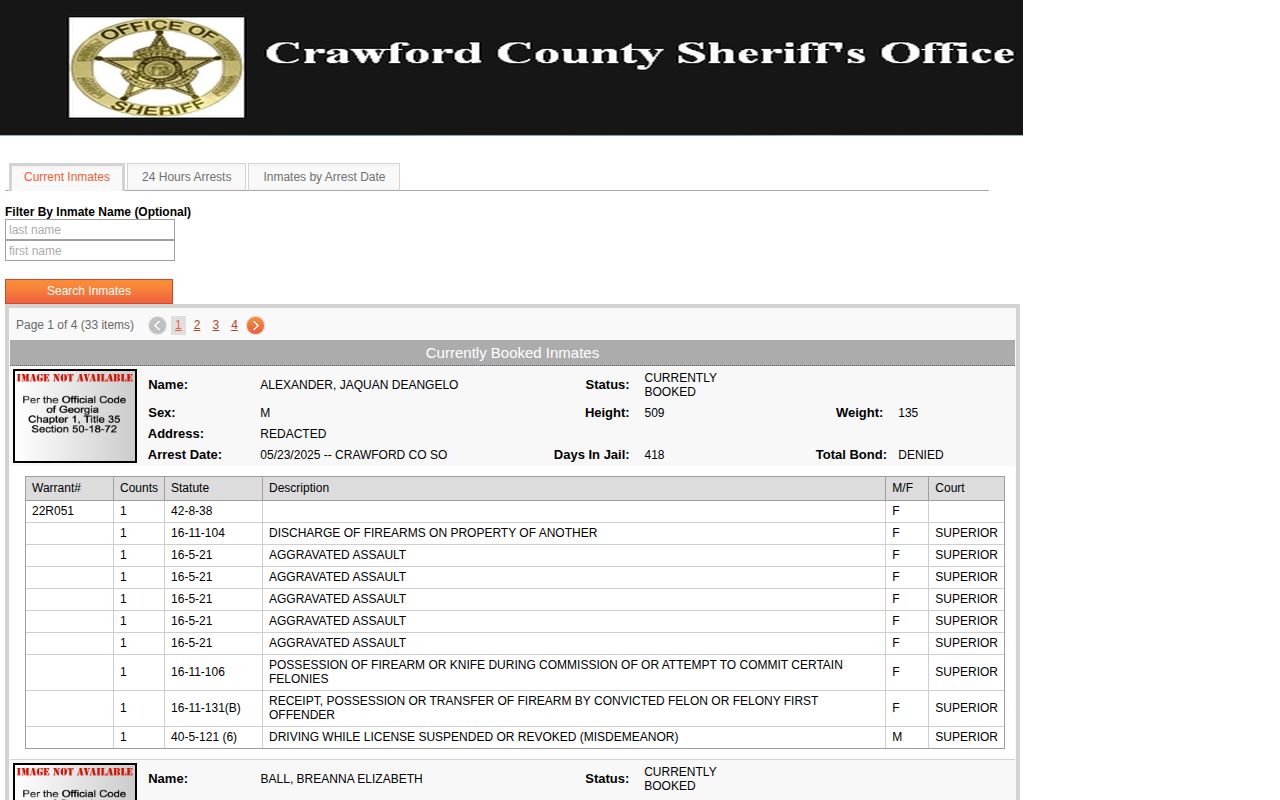
Its tabs separate current inmates, 24-hour arrests, and current inmates sorted by arrest date. None is labeled as a release archive.
Note: Crawford County does not publish how long a departed booking remains visible or how often the roster refreshes.
Find Crawford County Released Inmates
Start with the system that last held the person. For a local booking, search the sheriff’s current roster and the 24-hour arrest view. Save the booking details if a match appears. If no match appears, do not assume the person is free. A transfer, spelling difference, delayed update, or move to another authority can also remove a name from the expected view.
- Check the Crawford jail report for current custody and recent booking facts.
- Ask the sheriff’s records clerk for the release entry when the person has left the current list.
- Review Crawford Superior Court records for bond, disposition, sentence, probation, revocation, or dismissal.
- Search GDC when a felony sentence or transfer may have moved the person into state custody.
- Check the Parole Board and DCS when the person may be released but supervised.
- Use Georgia VINE for a custody event or alert, and BOP or ICE only when the case belongs to those systems.
The sheriff records entry is the best source for the exact jail-door release time. A court file explains the legal authority. A receiving system establishes whether “released from Crawford” meant release to the community or transfer. The Crawford County parole and probation page addresses the separate supervision check after custody ends.
Crawford Released Inmate GDC Search
The Georgia Department of Corrections Find an Offender tool is the state-prison route. It does not cover every person booked at the county jail. Someone who bonded out or served only a short local term may never have a GDC record. A person sentenced in Crawford Superior Court and transferred to GDC may disappear from the county roster while still confined by the state.
| Search field | How it helps |
|---|---|
| First and last name | Starts a broad identity search |
| GDC ID or case number | Narrows the result to a state record |
| Age | Separates people with the same name |
| Race and sex | Provides added matching details |
| Status and facility | Distinguishes active custody from a released or discharged record |
Open the likely result and compare it with Crawford court data. Look for status, facility, offense, sentence, and public release or discharge fields. A Tentative Parole Month is not proof of release. It is a month for final Parole Board review and may be postponed or cancelled. The GDC tool also carries an accuracy warning, so uncertain results should be confirmed with GDC or the originating court.
The official GDC query screen illustrates the state fields used after a Crawford transfer or prison sentence.
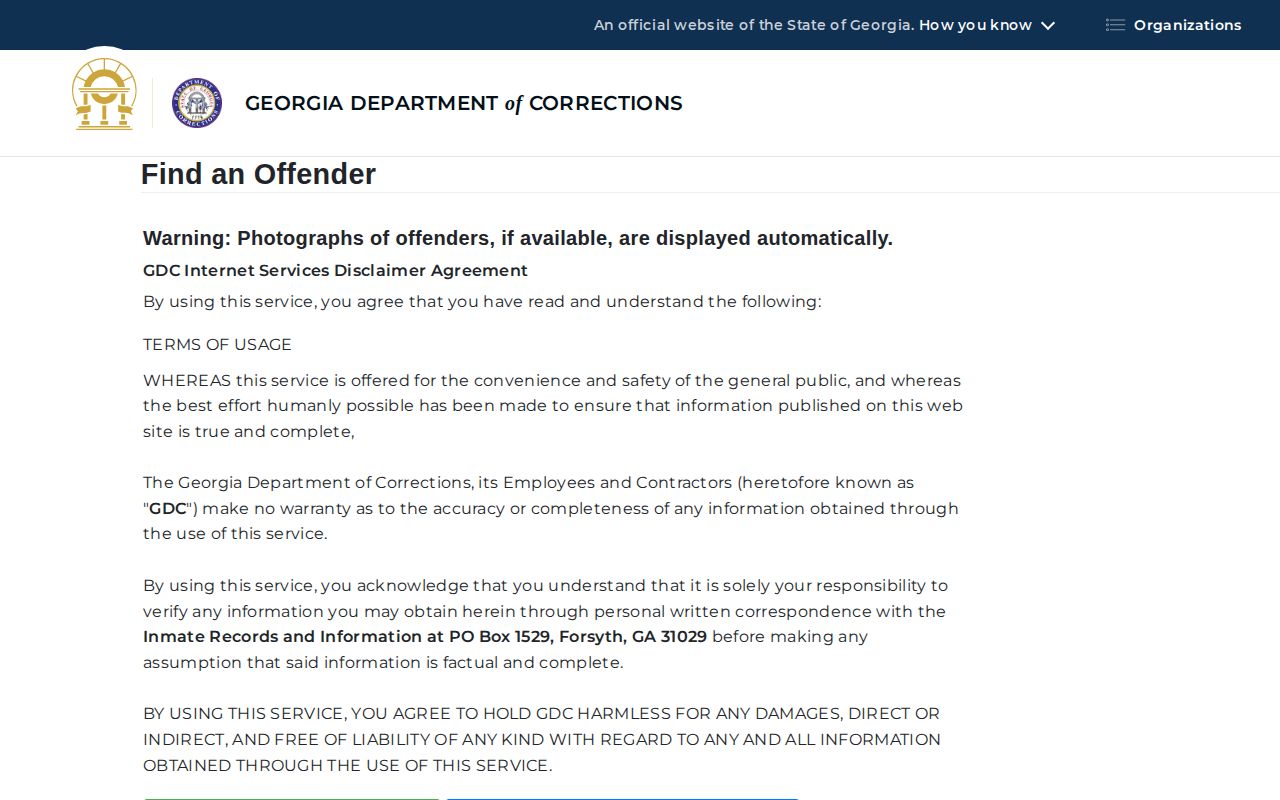
This statewide search complements the county roster; it does not replace Crawford jail release records.
Crawford Release Records Across Courts
Crawford’s court geography explains why one release may require two locations. The Clerk of Superior Court is in Knoxville and maintains the county case record. Crawford Superior Court is part of the Macon Judicial Circuit, while judge and criminal-docket contacts shown by the county may be in Macon. The clerk record is the sound starting point for a copy of the disposition, sentence, bond order, probation order, or revocation result. A judge’s office is not a substitute for the clerk’s file.
Georgia Courts e-access lists Crawford Superior through PeachCourt and notes that users are redirected to a provider and need an account. The local clerk can still explain access to official filed records. Court entries may not show the minute someone walked out of jail, but they can establish the legal act that made release possible.
Note: Use the Knoxville clerk for filed Crawford records; Macon Circuit contacts serve a different court-administration role.
Crawford Release Checks Beyond Jail
Georgia VINELink can provide custody status and notifications for participating agencies. Search one person by name or offender ID, verify the reporting agency, and register for a release or transfer notice if the person is still held. VINE can lag and is not a full booking sheet or court disposition. For a released state prisoner, the Parole Board’s parolee database and DCS may show community supervision after GDC custody ends.
Federal cases require the Bureau of Prisons inmate locator. BOP records cover 1982 forward. Its records guidance says a past date with no facility listed means the person was released from BOP custody on that date, though another justice system may still hold or supervise the person. Immigration custody requires the ICE detainee locator and a specific record showing a detainer or transfer.
- Still in Crawford jail
- Use the current jail population report and confirm through sheriff detention staff.
- Released from Crawford jail
- Request the sheriff release entry, then compare the court order or receiving system.
- State prison or discharge
- Use the GDC offender search, Parole Board, and DCS as the record requires.
- Federal custody or release
- Use the BOP locator and BOP records or FOIA.
- Immigration transfer
- Start with the sheriff transfer entry, then check the ICE detainee locator.
Crawford Releases and Immigration Holds
Crawford publishes a quarterly immigration compliance report under the Georgia Criminal Alien Track and Report Act. The Q2 2026 Crawford report lists 57 inmates booked, four LESC inquiries, four responses, no response identifying an illegal alien, and no USDHS detainers. That is a report for one quarter, not a statement that detainers never occur.
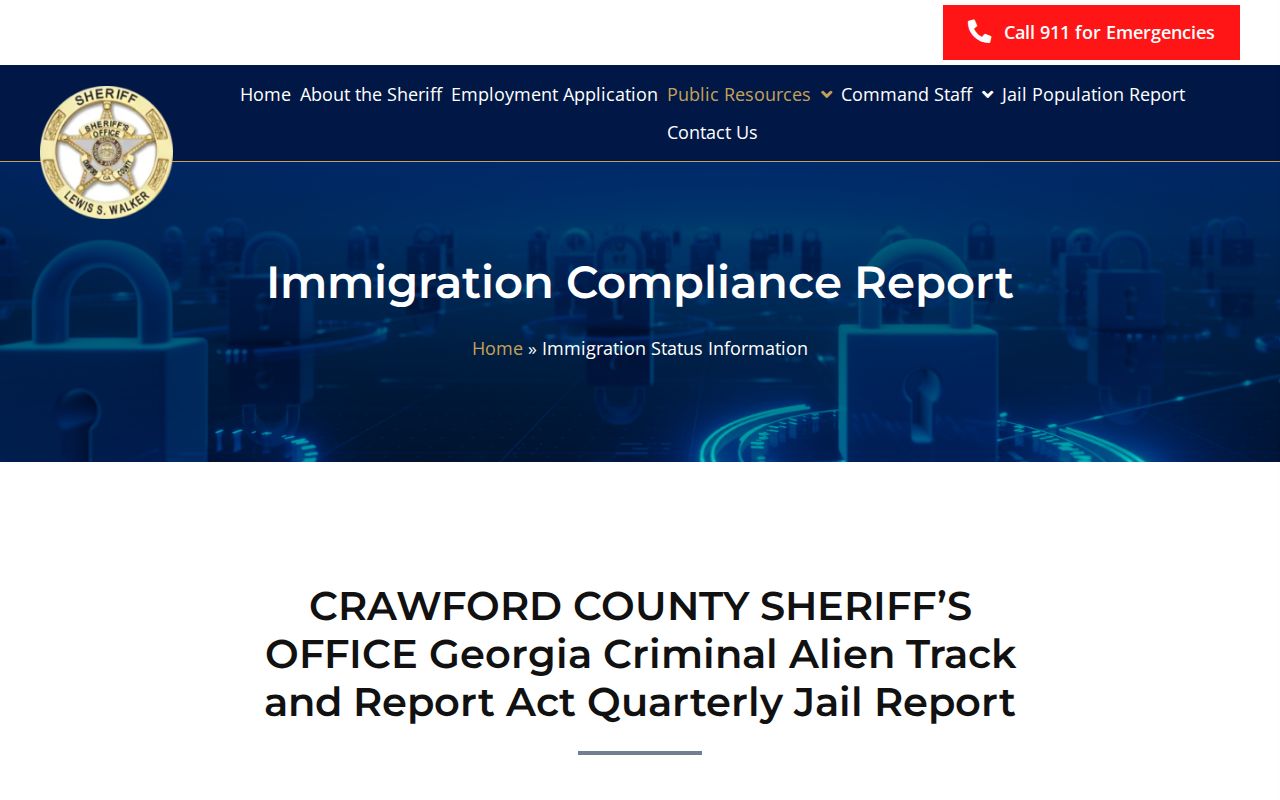
The local report shows why a release destination must come from the individual booking record. A future case may have a hold even though the captured quarter reported none.
Note: The Q2 2026 totals describe one reporting period and cannot decide the status of a different Crawford County booking.
Crawford County Release Facility
Crawford County Jail, also described as the sheriff’s detention center, is the county’s local detention facility at 21 Hortman Mill Road in Knoxville. It holds local pretrial and sentenced populations and people awaiting another custody decision. A person may leave for the community, GDC, another jail, federal custody, medical care, or another lawful destination.
The sheriff’s jail population report is the correct current-custody view. The records clerk is the correct release-record path. Neither the GDC statewide listing of the county jail nor the GDC offender search turns this county facility into a state prison. The system that accepted a transfer supplies the next status record.